
Peptide Capsules
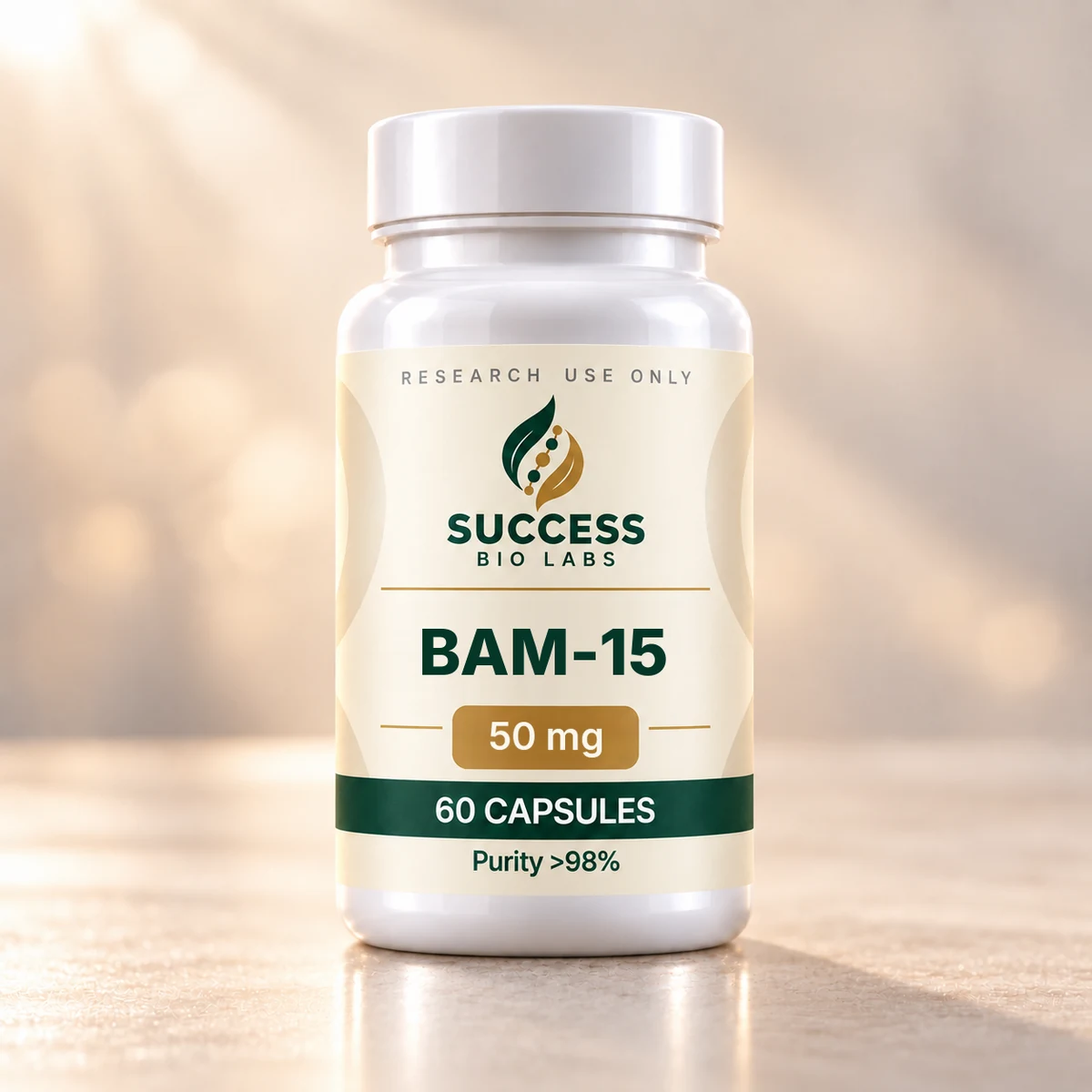
BAM-15 Capsules
BAM15, clearly identified. A small-molecule mitochondrial uncoupler, not a peptide, at 50 mg per capsule, 60 capsules per bottle.
✓ In stock and ready to ship
Product identification & intended use
SKU: SC-CAPS-BAM15-50MG
For laboratory research use only. Not for human or veterinary use.
Description
BAM15 is a synthetic small molecule that uncouples mitochondria: protons slip back across the inner membrane without making ATP, so a cell has to burn more fuel for the same energy output. We supply it as 50 mg capsules, 60 per bottle, Available analytical documentation is listed in the COA library.
Chemical identity & storage
| Compound / component | CAS number | Molecular weight | Specification status |
|---|---|---|---|
| BAM15 | 210302-17-3 | 340.31 g/mol Formula: C16H10F2N6O |
Catalog reference specification |
Storage: Store tightly closed in a cool, dry place at controlled room temperature (15–25°C), protected from heat, light and moisture.
What BAM15 is.
BAM15 often appears in peptide lists, but it is not a peptide. It is an oxadiazolopyrazine compound of about 340 g/mol.
Kenwood and colleagues described it in Molecular Metabolism in 2014 as an uncoupler that works on mitochondria without depolarising the outer cell membrane. In cell studies, that set it apart from older uncouplers such as 2,4-dinitrophenol (DNP).
At a glance.
| Chemical name | N5,N6-bis(2-fluorophenyl)[1,2,5]oxadiazolo[3,4-b]pyrazine-5,6-diamine |
|---|---|
| Compound type | Small molecule, not a peptide |
| Molecular formula | C16H10F2N6O |
| Molecular weight | ≈ 340.3 g/mol |
| CAS number | 210302-17-3 |
| Mechanism | Mitochondrial protonophore uncoupler |
| Labeled content | 50 mg per capsule |
| Count | 60 capsules |
| Catalog reference | SBL-8271 |
What the research looks at.
In diet-induced obese mice, BAM15 raised energy expenditure and cut fat mass without lowering food intake, and improved insulin sensitivity (Axelrod and colleagues, Nature Communications, 2020). Sepsis and kidney-injury models are other active areas. Nothing has been tested in people.
Related compounds.
For other metabolic research, see SLU-PP-332, 5-Amino-1MQ capsules, MOTS-c and tesofensine.
Documentation.
Available analytical documentation is organized by compound, strength and format in the COA library. Do not treat a report as lot-specific unless a documented lot match is shown.
Handling.
The capsules come pre-measured in a sealed bottle, so there is nothing to reconstitute. Keep the bottle tightly closed somewhere cool and dry, away from heat, humidity and direct light.
Questions.
Is BAM15 a peptide?
No. It is a small molecule, listed with our peptides because it is used in similar metabolic research.
What is a mitochondrial uncoupler?
A compound that gives protons a route around ATP synthase. Mitochondria then burn more fuel, and more of the energy comes off as heat.
How is BAM15 different from DNP?
In cell studies BAM15 worked on mitochondria while leaving the plasma membrane polarised. Older uncouplers like DNP depolarise it.
Further reading.
Six small molecules in peptide research, explained
For laboratory research use only. Not for human or veterinary use.
