
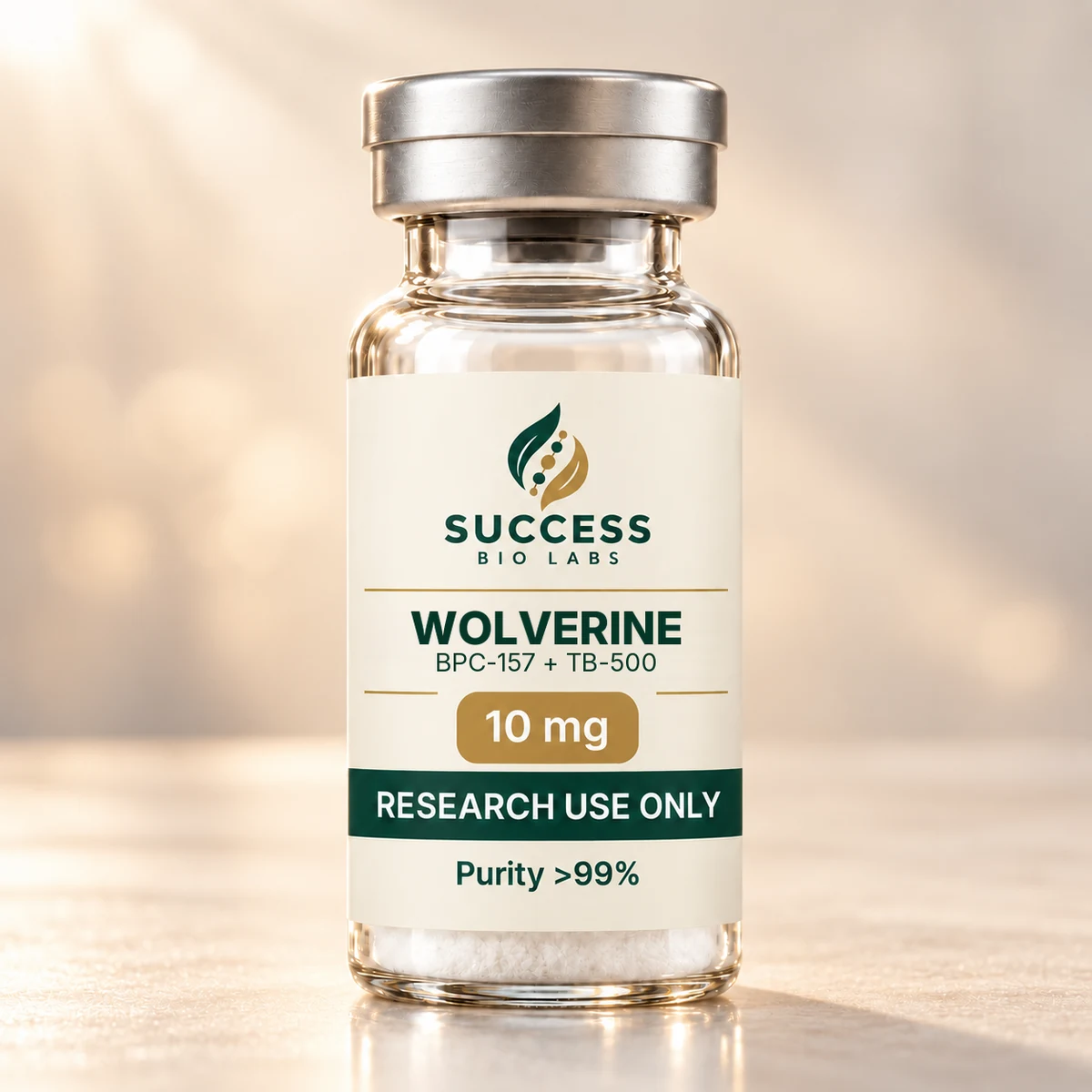
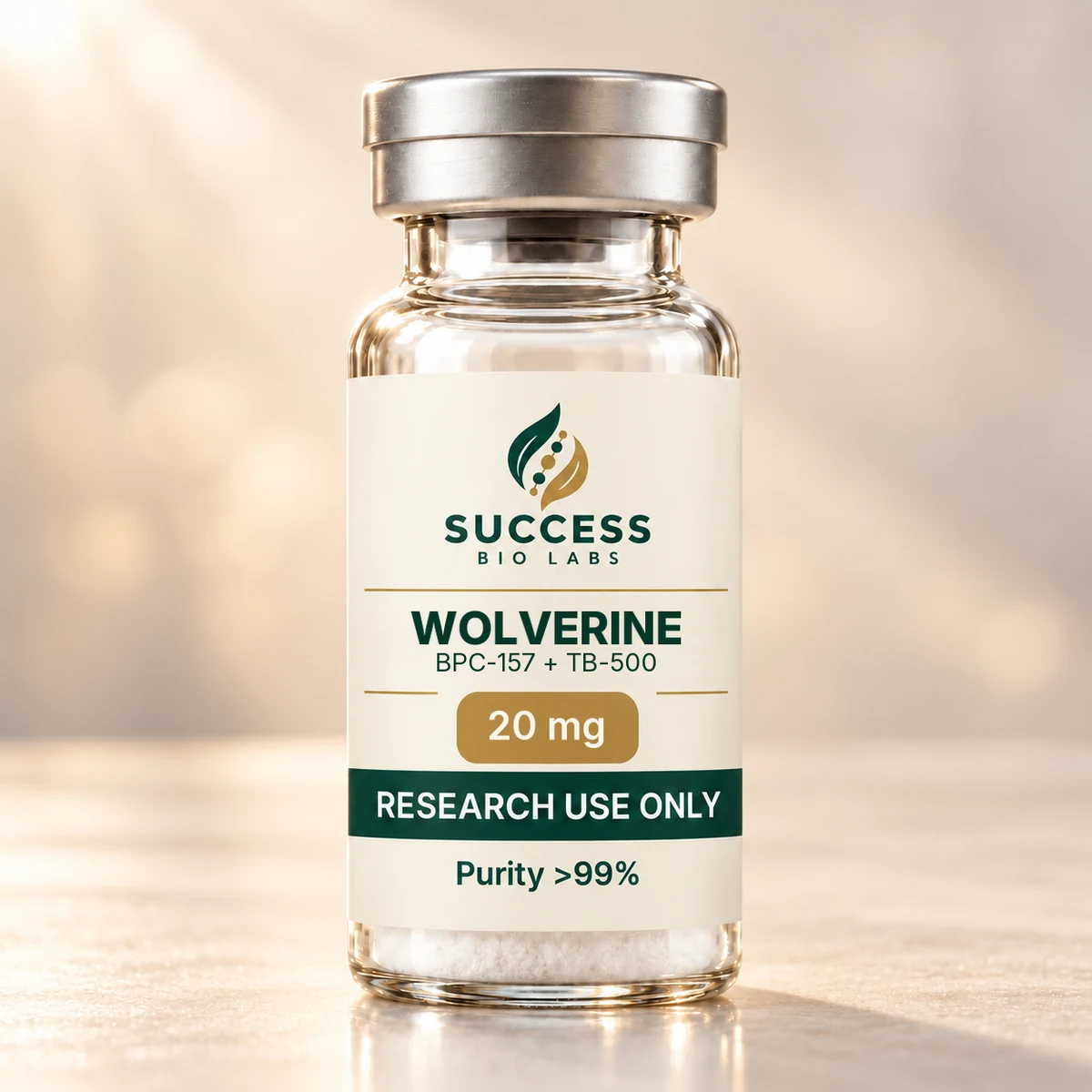
Peptide Vials
BPC-157 + TB-500 Blend Vial
BPC-157 + TB-500, clearly measured. Two repair-model research peptides at a 1 : 1 ratio, in 10 mg (5 + 5) and 20 mg (10 + 10) lyophilized vials.
Certificate of analysis View available reports and lot details
BPC 157 - 5 mg TB 500 - 5 mg
Product identification & intended use
SKU:
For laboratory research use only. Not for human or veterinary use.
Description
This blend puts BPC-157 and TB-500, two widely studied tissue-repair research peptides, into one lyophilized vial at equal amounts. Choose 10 mg (5 mg of each) or 20 mg (10 mg of each). Available analytical documentation is listed in the COA library.
Chemical identity & storage
| Compound / component | CAS number | Molecular weight | Specification status |
|---|---|---|---|
| BPC-157 | 137525-51-0 | 1419.5 g/mol Formula: C62H98N16O22 |
Catalog reference specification |
| Thymosin beta-4 (full length) | 77591-33-4 | approximately 4963.4 g/mol Formula: C212H350N56O78 |
Formulation-specific specification for the BPC-157 + TB-500 vials. |
This vial formulation uses full-length thymosin beta-4. It is intentionally different from the fragment used in capsules, sprays, GLOW and KLOW.
Storage: Keep sealed lyophilized material cold and protected from light. For long-term storage, keep at -20°C or below. After reconstitution, store at 2–8°C and avoid repeated freeze–thaw cycles.
What the blend is.
The two are often studied together because they appear to work in different ways. Early studies tie BPC-157, a 15-residue piece of a stomach protein, to new blood vessel growth and growth-factor signals. TB-500 is modelled on thymosin beta-4, a protein that grips actin and helps cells move. A premixed vial gives a steady ratio without preparing two materials.
A note on the name: the market uses TB-500 for both full-length synthetic thymosin beta-4 and its active fragment, Ac-LKKTETQ. Your lot’s COA confirms which one you have.
At a glance.
| 10 mg vial | 5 mg BPC-157 + 5 mg TB-500 |
|---|---|
| 20 mg vial | 10 mg BPC-157 + 10 mg TB-500 |
| Ratio | 1 : 1 by mass |
| BPC-157 | GEPPPGKPADDAGLV, ≈ 1419.5 g/mol, CAS 137525-51-0 |
| TB-500 | Synthetic thymosin beta-4-based peptide |
| Form | Lyophilized powder |
| Catalog reference | SBL-9877 |
What the research looks at.
Both peptides appear in animal and cell models of injury to tendon, ligament, muscle, skin and cornea. Thymosin beta-4 research centres on actin sequestration, cell migration and blood-vessel formation. BPC-157 research centres on angiogenesis, nitric-oxide signalling and growth-factor receptor expression. The evidence is mostly from animal and cell studies, and the combination has not been tested clinically.
Other formats.
The same blend comes as BPC-157 + TB-500 capsules and a BPC-157 + TB-500 liquid spray. For single compounds, see the BPC-157 vial and TB-500 capsules. With GHK-Cu added, see GLOW and KLOW.
Documentation.
Available analytical documentation is organized by compound, strength and format in the COA library. Do not treat a report as lot-specific unless a documented lot match is shown.
Handling.
Until it is opened, store the vial cold and dry, shielded from light. Most labs mix it with bacteriostatic water and refrigerate the solution once it has been reconstituted.
Questions.
What is the ratio?
1 : 1 by mass: 5 mg of each in the 10 mg vial and 10 mg of each in the 20 mg vial.
What is TB-500?
A lab-made peptide modelled on thymosin beta-4, an actin-binding protein found throughout the body.
How is this different from GLOW?
GLOW adds 50 mg of GHK-Cu to 10 mg each of BPC-157 and TB-500.
Further reading.
BPC-157 + TB-500 reconstitution calculator
BPC-157 formats compared: vials, capsules and spray
For laboratory research use only. Not for human or veterinary use.
