
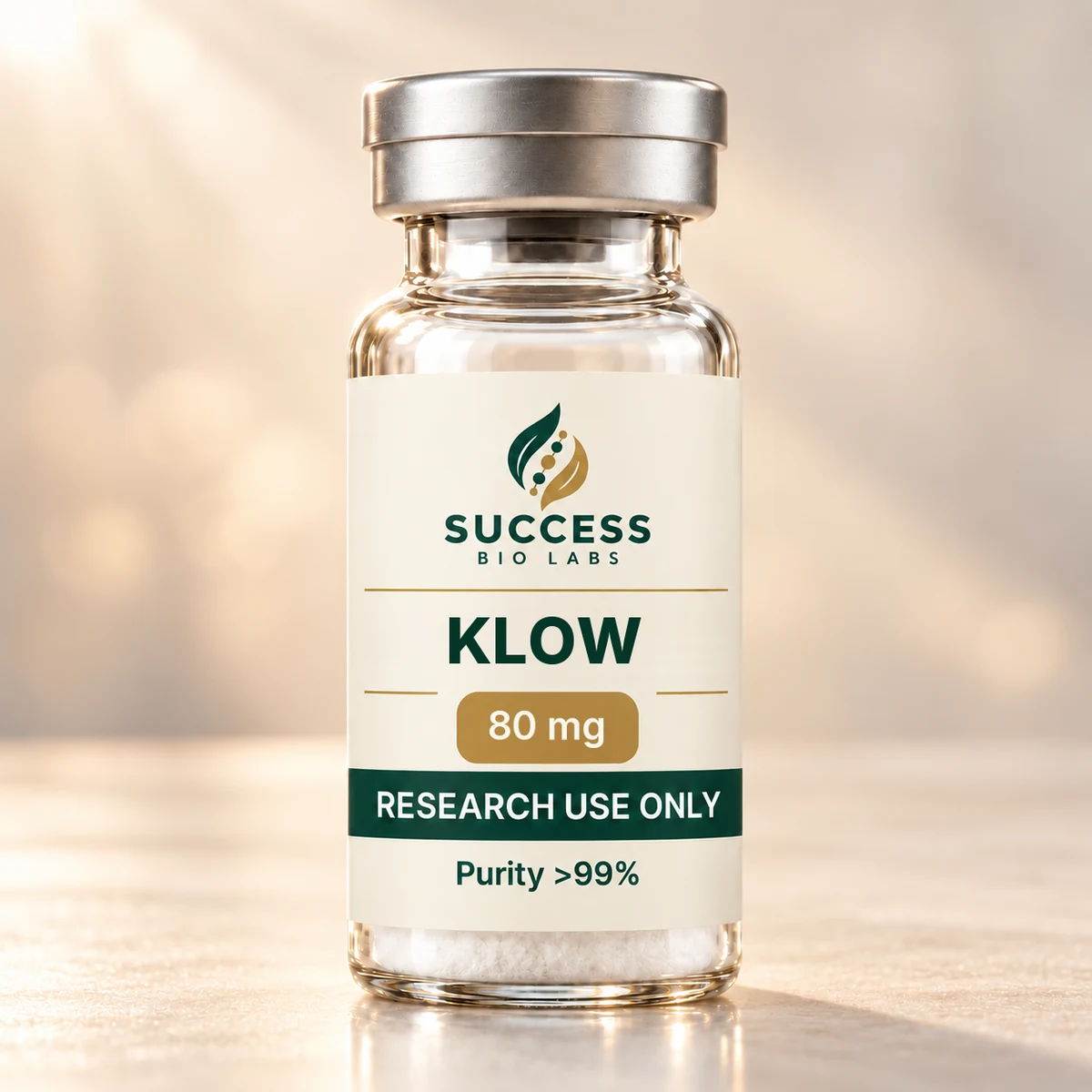
Peptide Vials
KLOW Peptide Blend 80mg
KLOW, clearly measured. Four research peptides in one 80 mg vial: GHK-Cu 50 mg, BPC-157 10 mg, TB-500 10 mg and KPV 10 mg, with analytical documentation listed when available.
✓ In stock and ready to ship
Certificate of analysis View available reports and lot details
Product identification & intended use
SKU: SC-VIAL-KLOW-10/50/10/10
For laboratory research use only. Not for human or veterinary use.
Description
KLOW is a research blend of four compounds in one lyophilized vial: the copper peptide GHK-Cu, BPC-157, TB-500 and the tripeptide KPV. Each vial holds 80 mg of total peptide, and with available analytical documentation listed in the COA library.
Chemical identity & storage
| Compound / component | CAS number | Molecular weight | Specification status |
|---|---|---|---|
| GHK-Cu (copper peptide) | 49557-75-7 | 403.9 g/mol Formula: C14H24N6O4Cu |
Catalog reference specification |
| BPC-157 | 137525-51-0 | 1419.5 g/mol Formula: C62H98N16O22 |
Catalog reference specification |
| TB-4 fragment (Ac-LKKTETQ) | 885340-08-9 | 889.02 g/mol Formula: C38H68N10O14 |
Formulation-specific label specification for capsules, sprays, GLOW and KLOW. |
| KPV | 67727-97-3 | 342.43 g/mol Formula: C16H30N4O4 |
Catalog reference specification |
Blend values are listed component by component; no mixture CAS number or mixture molecular weight is assigned.
Storage: Keep sealed lyophilized material cold and protected from light. For long-term storage, keep at -20°C or below. After reconstitution, store at 2–8°C and avoid repeated freeze–thaw cycles.
What the KLOW blend is.
KLOW starts from the three-peptide GLOW blend and adds KPV, a short fragment of α-MSH studied in inflammation research. The K is usually read as a nod to that extra KPV.
A blend gives a laboratory a fixed ratio of several compounds in one vial, instead of four separate materials to weigh and combine.
At a glance.
| Total content | 80 mg per vial |
|---|---|
| GHK-Cu | 50 mg |
| BPC-157 | 10 mg |
| TB-500 | 10 mg |
| KPV | 10 mg |
| Ratio | 5 : 1 : 1 : 1 (GHK-Cu : BPC-157 : TB-500 : KPV) |
| Form | Lyophilized powder |
| Catalog reference | SBL-9903 |
The four components.
GHK-Cu is a natural copper-binding tripeptide with a long record in skin, collagen and gene-expression studies. BPC-157 is a 15-residue gastric-protein fragment studied in preclinical tissue-repair models. TB-500 is a synthetic peptide based on thymosin beta-4, studied in cell migration and actin regulation. KPV is a Lys-Pro-Val tripeptide studied in inflammation and gut-lining models.
What draws researchers to the combination is that all four turn up in wound, skin and tissue-model literature, each through a different mechanism. Every component’s evidence is preclinical or early-stage, and no one has studied the finished blend itself.
Documentation.
Available analytical documentation is organized by compound, strength and format in the COA library. Do not treat a report as lot-specific unless a documented lot match is shown.
Handling.
Until it is opened, store the vial cold and dry, shielded from light. Most labs mix it with bacteriostatic water and refrigerate the solution once it has been reconstituted.
Questions.
What is in KLOW?
GHK-Cu 50 mg, BPC-157 10 mg, TB-500 10 mg and KPV 10 mg, for 80 mg in total.
KLOW or GLOW?
GLOW contains GHK-Cu, BPC-157 and TB-500 in a 70 mg vial. KLOW has the same three plus 10 mg of KPV, for 80 mg.
Why is there so much GHK-Cu?
GHK-Cu is a very small tripeptide, so formulations usually include it at a higher mass than the larger peptides.
Is KLOW approved for human use?
No. It is sold for laboratory research only.
Further reading.
KLOW reconstitution calculator
KLOW vs GLOW: how the two blends differ
What is KPV peptide? What the research shows
For laboratory research use only. Not for human or veterinary use.
